6 mins read

Role of generative AI in software testing
Software testing is being revolutionized by generative AI, which automates duties, increases test coverage, and finds hidden errors. These models make distinctions between irregularities and expected actions, which helps to uncover potential software issues that could otherwise go unnoticed. The article explores how generative AI may improve the efficiency and comprehension of the testing process, given the critical role that thorough testing plays in software development.
Test Case Generation
Generative AI models can examine huge quantities of software-related data, including written code, documents, and execution traces, to uncover hidden trends and anomalies. To guarantee that the software product being supplied to users meets the standards set by the company in question, it must be tested against a variety of situations. The goal of test case design is to ensure that every step of the product satisfies all criteria in both foreseeable and unforeseen conditions.
The manual writing of the many scenarios into written material, which outlines every action that may be needed for a step, is the traditional approach to constructing test cases. Large applications or products lead to complexity issues since the tester must comprehend and recognize every avenue that might be taken (Badgett & Myers, 2023). The high degree of expertise required of the tester not only drives up costs but also widens the knowledge gap across various software team disciplines. In test case generation, generative AI helps in ensuring test cases are generated in the correct formats, defining the inputs and ensuring the usefulness of the test cases, reducing noise or minimizing inaccurate data, and producing happy paths and corresponding edge cases (Johnsson, 2024).
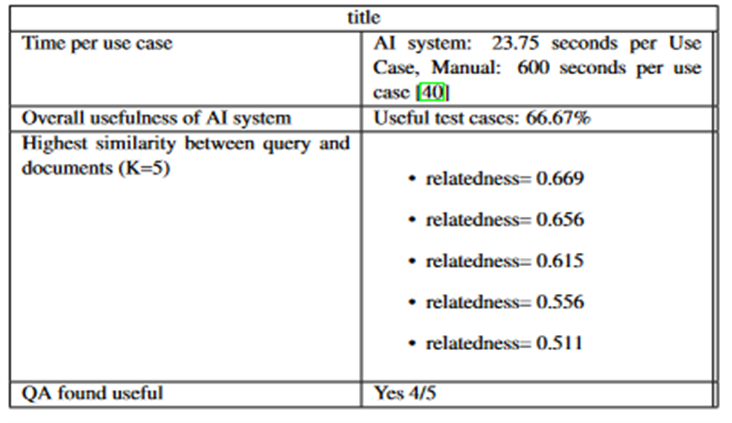
Figure 1 indicates a comparison of amounts across different categories. This shows the advantage of the application of generative AI in test cases. AI systems are advantageous in terms of happy paths, test cases, edge cases, and noise. Figure 2 shows how impactful generative AI is in terms of saving time. Quality assurance found the usefulness of AI to be at 4/5, which is a good score. We can draw conclusions from Figure 2 that employing the AI system greatly improved time efficiency. Total time efficiency continues to have a very positive effect on the efficiency of software development (Johnsson, 2024).
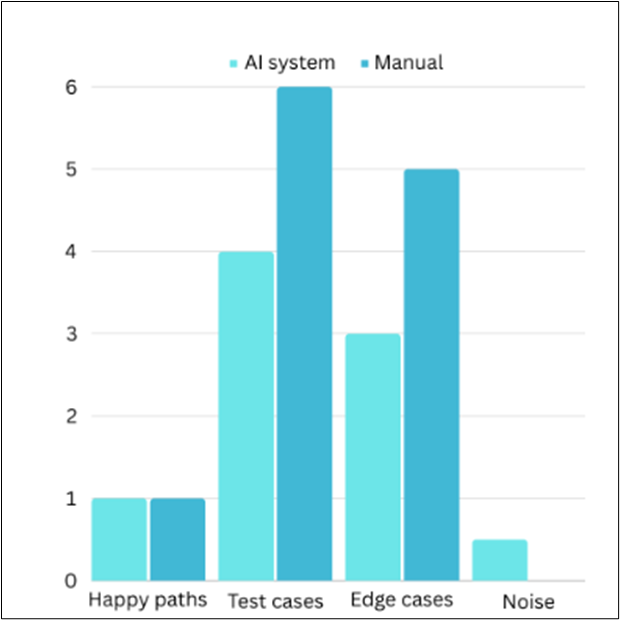
Figure 1: A comparison between manual and AI creation of test cases, source (Johnsson, 2024)
Data Generation for Testing
Realistic, but fake, data is needed to conduct software tests. For instance, real client names and addresses are not used to test banking software applications (Baudry et al., 2024). . The process of creating artificially created datasets that resemble real-world data is known as synthetic data production. This method ensures that no private or sensitive information is revealed while generating data points with statistical traits and patterns that are comparable to the original data. Synthetic data production is revolutionizing a number of fields, including machine learning, and privacy-focused studies. Because of its wide range of uses, it is an essential tool for businesses looking for creative solutions. Data-related problems prevent many firms from fully utilizing artificial intelligence (AI) technologies. The challenges of real data include data regulations, sensitive data, financial implications, and data availability. Software programs, algorithms, and information processing networks are just a few of the parts of data-centric systems that are tested and validated using synthetic data. Developers may evaluate the reliability and efficacy of their systems by creating customized test cases, edge situations, or outliers (Gill, 2024).
Baudry et al. (2024) highlight three aspects that are important for data generation and testing. These are domain adequacy (data appropriateness for a specific application), executability (ability of successful execution of the data to completion), and interoperability (generation of highly accurate end-to-end test data). Even though AI models are quite effective at generating data, Baudry et al. (2024) also find that cultural appropriateness differs depending on the job and prompt language. Serious and interesting software testing may be supported by the full success of AI-generated test fakers.
Benefits of Generative AI
Generative AI is transforming software testing by streamlining the detection and reporting of issues, enhancing the efficiency of software programs. By generating various scenarios and test cases, it can uncover potential errors in the code, ultimately improving the quality and reliability of software systems. Moreover, generative AI can automate the testing process, eliminating the need for manual testing which can be time-consuming and prone to errors. This benefits both developers and users by expediting software development timelines and enhancing the overall software product delivery.
In a constantly changing technical context, generative AI is revolutionizing software quality assurance by removing manual labor and speeding up the supply of high-quality apps. It offers richer coverage than previously possible while assisting testers in keeping up with the rate of change. More thorough testing may be accomplished by simulating user behavior and tasks with the help of generative AI. By doing this, developers may gain a better understanding of how their program might operate in unforeseen situations, including when several users are logging on at once. Organizations may develop more dependable and durable apps by using testing powered by generative AI. This lowers the related expenses and facilitates the attainment of the intended quality targets (Functionize, 2024) (Aleti, 2023).
Tools/techniques
First are AI-powered test automation frameworks, which are software solutions that use AI to automate the generation and running of test scripts. These are known as AI-powered automated test frameworks. These frameworks provide automated test cases that may be used to find errors and guarantee software product quality by using AI algorithms to examine apps and user behavior. The tools include AI-enabled Selenium, Mabl, and ACCELQ (Navarathna Mudiyanselage, 2024). Second are generative adversarial networks (GANs). These are a particular kind of deep learning architecture that uses two rival neural networks to accomplish a shared objective: producing fresh, accurate data. The components for these are a generator and a discriminator (Dash et al., 2023). Third is the technique of artificial intelligence called natural language processing (NLP), which focuses on enabling computers to have the same comprehension, interpretation, and processing capabilities as humans. The tools for NLP are open-source libraries and cloud-based services (Τσίγγανος, 2023).
Sample approach use case
Case: Testing a new function that enables consumers to customize product bundles in an e-commerce application.
NLP first examines the functional requirements and user stories for the product’s bundle functionality. After that, test cases covering different characteristics are automatically generated. These might involve managing variations in product availability and using different discount coupons. Past product information, customer behavior patterns, and sales data from the past are used for training a GAN. This enables GANs to provide synthetic test data that is realistic for a range of settings. The different settings include product bundles with various category blends (e.g., gadgets, clothes, etc.) and user accounts with various buying histories and demographics. Purchasing carts with different product prices and quantities.