4 mins read
Data is in charge in today’s society, directing our choices and forming our tactics. We now inhabit what some refer to as the “data-driven framework,” in which each online transaction, click, and purchase generates a wealth of insightful data.
Leading organizations in this new context present previously unheard-of difficulties. Now, we will be talking about data-driven decision-making. Being an expert in this field, you are standing on the edge of a revolutionary period in which the use of data effectively is crucial to survive in the current market.
Understanding the data-driven approach
Being data-driven isn’t just trendy jargon — it’s a game-changer for how decisions are made and businesses succeed. To really get what a data-driven approach means nowadays, think of it as using data and analysis in a smart way to guide important business moves.
This approach isn’t just visible in one or two industries — it’s making an impact everywhere. It doesn’t matter which industry it is be it retail, healthcare, finance, or manufacturing. Companies are taking advantage of data-driven decisions for businesses to run smooth operations, improve the customer experience for their customers when it comes to services or products, and always stay ahead of the competition.
The role of leadership in a data-driven world
When it comes to a data-driven approach, it is clear that leadership holds the ground when comes to steering organizations toward success. Leaders need to adapt to this change to keep up with today’s competitive business world.
Nowadays, leadership isn’t only about relying on past experiences or instincts to make decisions. It is about recognizing the power of data and harnessing it to drive strategic moves. Leaders should actively seek out data-driven approaches, understand them deeply, and use them to guide their business strategies.
To thrive in this data-driven framework, leaders must have specific qualities and skills. There needs to be a robust presence of analytical skills, where they would be able to make a scene of the complex data-driven frameworks and jot down valuable insights from them. They should also be forward-thinkers, where they can see how data can be used to predict market trends and seize the opportunities coming their way!
Moreover, creating a culture that values data literacy and innovation is crucial for organizational success. Leaders should prioritize education and training efforts to ensure that everyone in the organization understands the importance of data and feels confident using it in their data-driven decision-making. By fostering a culture that embraces a data-driven approach, organizations can unleash innovation and achieve sustainable growth.
Challenges and opportunities for data-driven leadership
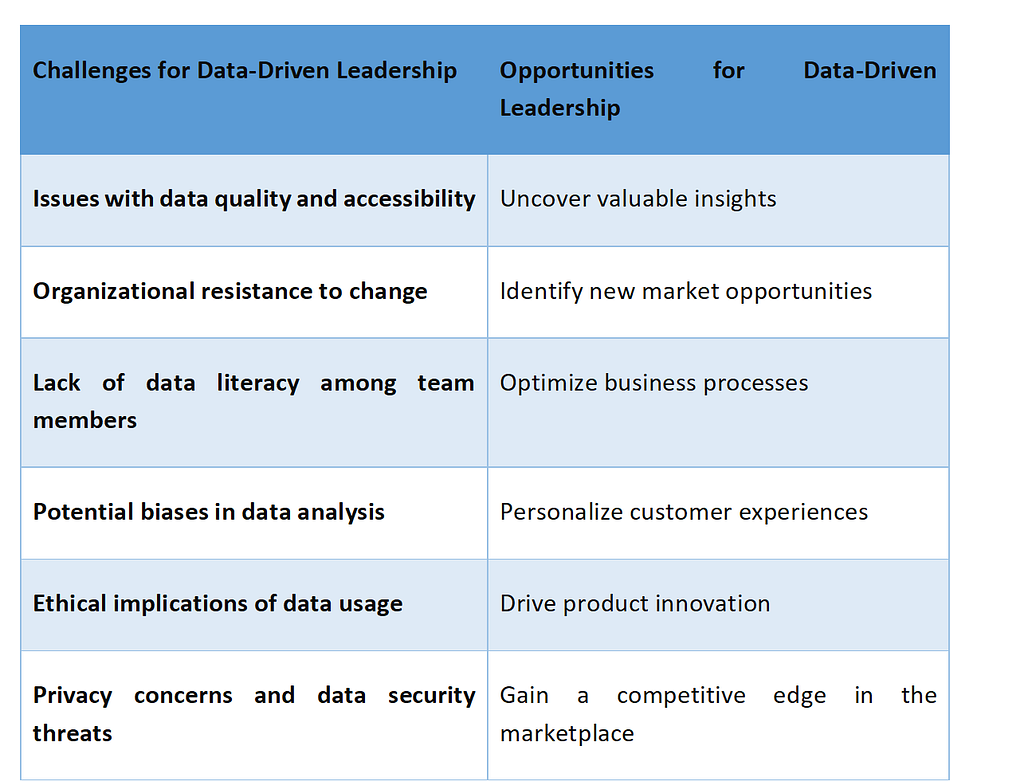
When leaders dive into the world of data-driven approach, they face a mix of challenges and opportunities to thrive. It’s crucial to understand these ups and downs to navigate through the complexities of this landscape successfully.
Common hurdles arise as leaders accept data-driven approaches. These include grappling with data quality and access issues, dealing with resistance to change within their organizations, and overcoming a lack of data know-how among team members. Tackling these challenges means investing in better data systems, fostering a culture where everyone understands and can use data effectively, and providing the right training and support to staff.
Furthermore, making decisions based on data does come with a few risks. Leaders need to watch out for biases during data analysis and think carefully before using this data ethically. There is also a big concern when it comes to privacy and keeping the data secure in this modern digital age. To keep up-to-date with these risks, leaders must prioritize accountability, openness, and robust data-driven frameworks for managing data.
However, despite these risks and challenges, data-driven leadership offers amazing opportunities when it comes to innovation and growth. With the correct data-driven approach, leaders can utilize valuable insights, locate new opportunities in the market, and streamline their work. When it comes to such data, customers can get more personalized experiences, move ahead with innovation in their products, and stay ahead of the competition.
Case studies
1. Company X: Making Smarter Moves with Data [1]
Story: Let’s talk about Company X, a manufacturing firm that was in a bit of a rut. The company was not able to keep up with the changes in the market and was falling behind its competitors. However, once they got their new leadership on board, there were some serious changes. The new leaders were able to use data-driven frameworks which allowed accurate numbers about their production, what their customers preferred, and what was occurring in the market.
Outcome: With these new leaders, Company X started looking at their operations in a whole new way. They used fancy tools and analytics to figure out exactly what was going on in their factories, what customers wanted, and what was happening in the market. This helped them make smarter decisions, faster.
Once they had all this data in hand, Company X went to work making things run smoother. They found ways to cut down on waste and make their production lines more efficient. This not only saved them money but also made them more productive overall.
Understanding what customers want is super important for any business. With all the data they had, Company X could see trends in the market and what people were buying. So, they adjusted their products and how they marketed them to match what customers were looking for.
And guess what? All these changes paid off big time! By using data to make better decisions, Company X started raking in more cash than ever before. They were making smarter products, wasting less, and selling more. It was a total game-changer for them.
Could not put in any hypothetical numbers or facts since it would cause a controversy to the readers. The readers might expect after seeing this blog that “yes, this is what i can expect if I implement these strategies” however, if they are not able to achieve those number for their business, it might cause some serious issues. I have however explained the outcome in a more detailed and easy to understand tone.
The future of data-driven leadership
Looking ahead at how leadership is evolving in a data-driven world, we’re in for some big changes. We’re talking about a whole new way of running things, thanks to new trends and fancy tech.
With the help of new tools, leaders can explain complicated data to their team members to make sure that everyone is on the same page. This eventually would result in better communication and support from everyone on the team.
Here is a quick sneak peek at how to collaborate with a robust data-driven approach:
Data visualization tools
Think about tools like Tableau, Power BI, or Google Data Studio as magic wands for leaders. They take boring, raw data and turn it into colorful, easy-to-understand charts, graphs, and dashboards that anyone can comprehend.
Collaborative platforms
Now, let’s talk teamwork! Platforms like Microsoft Teams, Slack, or Asana are beneficial where your team can address issues and communicate with each other in real time.
Training and education programs
We all know that knowledge is power! Offering training sessions or workshops on data literacy and interpretation is like giving your team superpowers.
Conclusion
However, it won’t be that easy! With these new opportunities come some tough setbacks. Leaders need to deal with privacy issues, keeping the data of their customers safe along with making sure that these new tools are easy to use for everyone.
To make sure they’re ready for whatever comes their way, leaders need to keep learning new stuff all the time. They should get better at using data, get used to AI and ML, and encourage their teams to try new things.
By staying on top of all these changes, making sure everyone values the data-driven approach, and always doing what’s right, leaders can make sure their team does well in this new time.
Thus, you should get in contact with Adeptview since we provide opportunities when it comes to data-driven approaches for businesses. With data skills, ethical decision-making, and innovation, we can help you to build a brighter tomorrow!