5 mins read
Introduction:
This is the first in a planned series of articles in which we introduce the topic of SRE (Site Reliability Engineering). As the digital landscape constantly changes, reliable systems are critical to avoid disruptions that can be very damaging. Site reliability engineering or SRE was coined at Google & the idea is closely related to the principles of DevOps. It is an approach to IT operations. SRE teams use the software to manage systems, solve problems, and automate operations tasks. SLOs, or service level goals, are among the core concepts of SRE because they represent a paradigm shift in the way that dependability is actually measured and enforced.
Why SRE?
Software Reliability Engineering (SRE) bridges the gap between software engineering and IT operations. When it comes to becoming ready for system failures in production, SRE is relevant. It guarantees the automation, predictability, scalability, and dependability of the company’s systems.
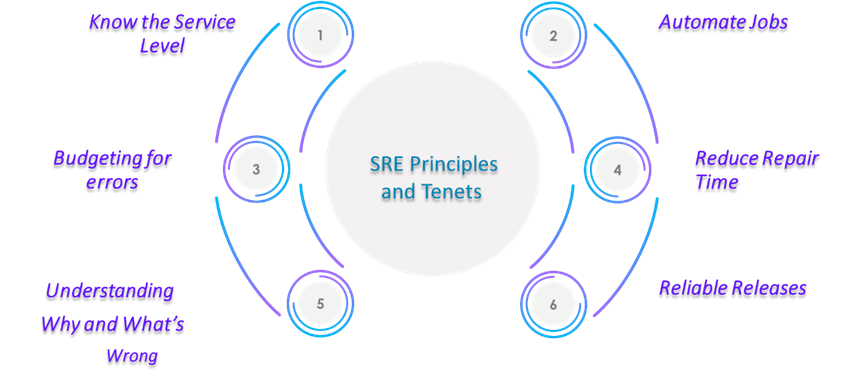
Key SRE Principles and Tenets
Service Level — SLIs, SLOs, and SLAs
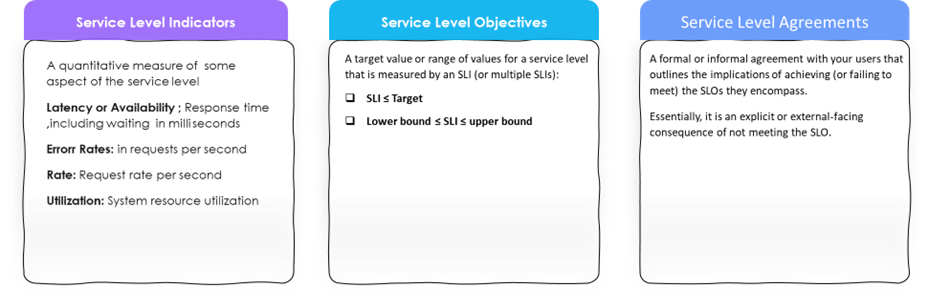
SLI: A carefully defined quantitative measure of some aspect of
the level of service that is provided.
SLO: A target value or range of values for a service level that is measured by an SLI. A natural structure for SLOs is thus SLI ≤ target, or lower bound ≤ SLI ≤ upper bound.
SLA: An explicit or implicit contract with your users that includes consequences of meeting (or missing) the SLOs they contain
SRE Metrics
Error Budgets
Product velocity and service reliability are often conflicting priorities for development teams and SRE teams. Error budgets are great because they allow teams to set a clear goal for acceptable downtime or service disruptions within a certain time limit. By establishing a realistic SLO and error budget, both teams can work together to take risks and tackle critical issues. This fosters a culture of shared responsibility across different teams allowing for innovation while maintaining service reliability within acceptable parameter.
- SRE’s goal is no longer “zero outages;” rather, SREs and product developers aim to spend the error budget getting maximum feature velocity.
- An outage is no longer a “bad” thing — it is an expected part of the process of innovation, and an occurrence that both development and SRE teams manage rather than fear.
- Whenever a service exceeds their error budget, ALL WORK MUST be related to improving availability.
Understanding Why and What’s Wrong
If you lack the ability to monitor a service, you are unaware of its status, which undermines your reliability.
- A complex application’s monitoring is a major technical task in itself.
- Monitoring should answer the questions: — What is wrong? — Why is it wrong?
- Alerts: Indicate that something is happening or about to happen that requires someone to act immediately.
- Tickets: Indicate that action is necessary on the part of a human, but not right now.
- Logging: The data is collected for forensic or diagnostic reasons, but it is not visible to anybody.
- Typically, SLIs are not metrics that are helpful for the general functioning of the system but do not have a significant impact on user interactions.
Work to Minimize Toil
The belief is that if machines can perform desired operations, then any time spent on operational tasks is not used for project work., which is crucial for making services more dependable and scalable. SRE also identifies sources of toil and pushes new features and changes to maintain engineers’ familiarity with the service’s workings.
Automate the Jobs
The focus is on selecting which jobs to automate, when to automate them, and how to do so. Google’s approach to SRE includes a 50% limit on time spent on “toil” tasks that do not create lasting value. This limit serves as a guarantee rather than a restriction, encouraging teams to take an engineering-focused approach to problem-solving. As automation progresses, SRE teams end up automating.
Reduce Repair Time
Mean Time to Repair (MTTR), or repair time, is a critical measure for SRE teams. Lower MTTR results in increased system uptime and quicker incident recovery. Few of the strategies that can be employed are.
- Invest in proactive maintenance.
- Standardize procedures.
- Automate routine tasks.
- Incident tracking and analysis
- Knowledge sharing & Training
Reliable Releases
Running reliable services requires reliable release processes.
Continuously build and deploy, including– Automating check gates– A/B deployments and other methods for checking sanity
Implement automated tests throughout the development process to catch potential issues early.
Set up well-defined and effective protocols for swiftly reversing deployments in the event of unforeseen problems or a decline in service dependability.
Apply engineering principles to oversee configuration management, which includes:
Handling configuration as code, incorporating:
· Version control
· Reviews and validations
· Testing
· Change management.
Automating the process of configuring “deployment.”
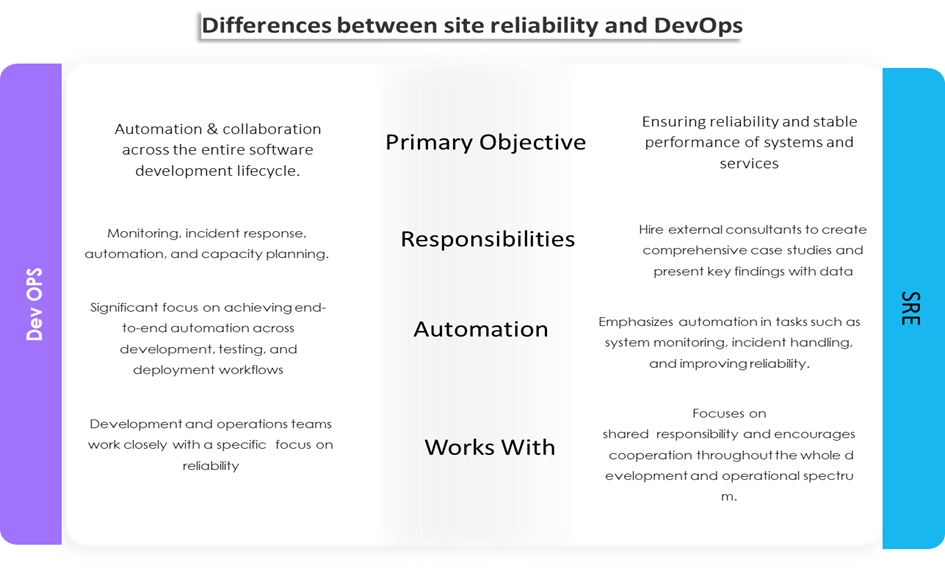
SRE vs DevOps
Although SREs and DevOps engineers both aim to improve system reliability and efficiency, their approaches and areas of emphasis diverge. SREs concentrate on ensuring the reliability and availability of websites or applications. They employ automated tools to proactively avert issues and promptly address any incidents that occur. For instance, in the event of a sudden surge in website traffic, an SRE may ensure that the system dynamically scales to manage the load, thereby preventing downtime.
Conclusion:
SRE is a vital discipline that enables uninterrupted operations and peak system efficiency. SRE is a continuous process towards excellence, with a focus on reliability and a commitment to driving innovation and stability in the digital landscape.